Public confidence in health information depends on more than the presence of a scientific reference. It also depends on who asked the research question, who funded the work, how the findings were reported and whether the conclusions match the evidence. The tobacco industry provides a well-documented example of why these questions matter.
Historical investigations show how tobacco companies used research funding, public relations and apparently independent experts to weaken public understanding of smoking-related harm. More recent investigations have examined concealed academic relationships, the promotion of heated-tobacco products and sponsorship of medical education. Together, these accounts show that influence can operate throughout the process by which evidence reaches clinicians, policymakers and the public (Brandt, 2012; Braznell et al., 2025; Boytchev, 2024).
As a public health specialist, I believe this history deserves attention whenever the industry seeks the confidence of a trusted institution. Scrutiny must be rigorous and fair. A conflict of interest is a reason to examine evidence carefully; it is not, by itself, proof that every finding is false.
1 How scientific uncertainty became a commercial strategy
In the early 1950s, accumulating evidence linked cigarette smoking with lung cancer. Tobacco companies responded by coordinating a public relations campaign and establishing the Tobacco Industry Research Committee. Research sponsorship offered a way to present the industry as a responsible participant in scientific inquiry while maintaining public uncertainty about the harms of its products (Brandt, 2012).
The central strategy was to keep controversy alive. By promoting alternative explanations and emphasising unresolved questions, the industry could make the evidence appear less conclusive than it was. Brandt’s historical analysis describes how this manufactured uncertainty undermined public health action and regulatory intervention. The problem was not the existence of unanswered scientific questions. It was the deliberate use of uncertainty to distort the public meaning of the available evidence (Brandt, 2012).
2 The appearance of independent expertise
As evidence concerning second-hand smoke developed, the industry extended its efforts beyond its own laboratories. Barnoya and Glantz (2006) documented an international programme, beginning in 1987, through which Philip Morris and other tobacco companies recruited scientific consultants in Europe and Asia. A law firm acted as an intermediary, reducing direct contact between the consultants and the industry.
Consultants undertook research and participated in scientific meetings without acknowledging industry funding. The programme sought to influence public debate and resist restrictions on smoking. The source of the message mattered: a claim delivered by an apparently independent academic could carry authority that the same claim from a cigarette manufacturer would lack (Barnoya & Glantz, 2006).
The language of scientific quality was also used strategically. Ong and Glantz (2001) examined Philip Morris’s “sound science” campaign, which challenged evidence on second-hand smoke and sought to influence standards for accepting epidemiological findings. Involving other industries and issues helped obscure tobacco’s role. Their analysis illustrates how an appeal to methodological rigour can become a public relations instrument when the standards are shaped to protect a commercial interest.
3 New products and continuing questions about transparency
The history does not establish that every contemporary tobacco study is unreliable. It does, however, make transparency essential when companies claim that their scientific practices have changed.
Braznell et al. (2025) analysed leaked documents concerning Philip Morris International and its Japanese affiliate. They identified payments for consultancy activities involving scientific opinion leaders and academic events. They also documented funding of a university smoking-cessation study through an intermediary, with no public record of the tobacco company’s involvement found by the investigators. The university study did not directly investigate IQOS, a distinction that should be preserved when describing the case.
A separate document analysis examined the Foundation for a Smoke-Free World during 2017–2021. The authors identified industry-favourable outputs, obscured industry involvement and support for third parties that criticised science or scientists whose work could threaten industry interests. They interpreted these activities as continuing earlier patterns of corporate influence on science (Legg et al., 2024). These findings concern the activities and period examined; they should not be extended automatically to every person associated with the organisation or to all subsequent work.
4 IQOS and the distinction between exposure and disease risk
Heated-tobacco products such as IQOS belong within tobacco-control scrutiny. They should nevertheless be described accurately. A product that heats tobacco differs from a combustible cigarette and from an electronic cigarette that heats a liquid. Those distinctions matter when evaluating emissions, exposure and health outcomes.
One particularly important distinction is between reduced exposure to certain chemicals and demonstrated reduction in disease risk. Lempert et al. (2022) examined the US Food and Drug Administration’s July 2020 authorisation of specified reduced-exposure claims for IQOS. That authorisation did not permit claims that IQOS reduced tobacco-related disease risk. The authors documented subsequent international messaging that blurred these categories and used the decision to support policy advocacy.
For public communication, the lesson is straightforward. A statement about selected chemical measurements must not be expanded into a broader assurance than the evidence supports. Lower exposure to some toxicants does not itself quantify a reduction in cancer, cardiovascular disease or other long-term outcomes. Equally, criticism of exaggerated claims does not establish that all tobacco and nicotine products have identical risks. The comparison, outcome and population must remain explicit (Lempert et al., 2022).
5 From tobacco products to inhaled medicines
The acquisition of Vectura by Philip Morris International in 2021 introduced another form of concern. Vectura specialised in inhaled medicines and drug-delivery technology. Tobacco ownership therefore created a financial connection between a company selling harmful tobacco products and medicines used by people with respiratory disease.
Capstick and Hopkinson (2021) discussed the ethical implications for respiratory care, including the possibility that prescribing decisions could financially benefit the tobacco industry. This case is relevant to institutional trust and conflicts of interest. It does not, on its own, demonstrate that research was falsified, that a particular medicine was ineffective or that a therapeutic inhaler had become a tobacco product. The documented ownership conflict is serious enough without adding claims the evidence does not establish.
6 Medical education as a channel of influence
Research findings reach clinical practice partly through continuing medical education. Sponsorship of that education can therefore provide access to a trusted professional audience.
In 2024, The BMJ reported on Medscape courses funded by Philip Morris International and their subsequent withdrawal after investigation and professional criticism. Internal planning documents described an extensive educational programme. Critics raised concerns about the framing of non-cigarette nicotine products and the commercial interests of the sponsor (Boytchev, 2024).
The concern extends beyond whether an individual slide contains an incorrect statement. Topic selection, choice of speakers and emphasis can influence the overall message. A course may cite genuine studies while presenting an incomplete account of alternatives, uncertainties or limitations. The Medscape case demonstrates why disclosure of funding must be accompanied by scrutiny of the educational content and its governance (Boytchev, 2024).
7 What trusted institutions should require
Universities, healthcare organisations, professional bodies, religious institutions and public agencies hold public trust. When a tobacco company seeks engagement with them, I would recommend that they ask five questions before allowing commercial claims to acquire institutional credibility.
First, who funded the evidence, including through foundations, consultancies or other intermediaries? Second, do the cited studies actually support the claims being made? Third, have relevant limitations and conflicting findings been presented? Fourth, does a regulatory decision authorise the precise claim being repeated? Fifth, have independent experts with no financial relationship to the industry been given an opportunity to assess the material?
These questions protect both scientific integrity and institutional independence. They also allow legitimate evidence to be evaluated without accepting a sponsor’s interpretation by default. A meeting, sponsorship or presentation should never be allowed to imply endorsement unless the institution has explicitly reached and explained that position.
The public health response must meet the same standard of accuracy that it demands from industry. We weaken our argument if we exaggerate findings, confuse product categories or treat a conflict of interest as proof of fraud. The documented record already provides substantial grounds for scrutiny. Our responsibility is to ensure that public trust rests on transparent evidence, careful interpretation and the protection of health.
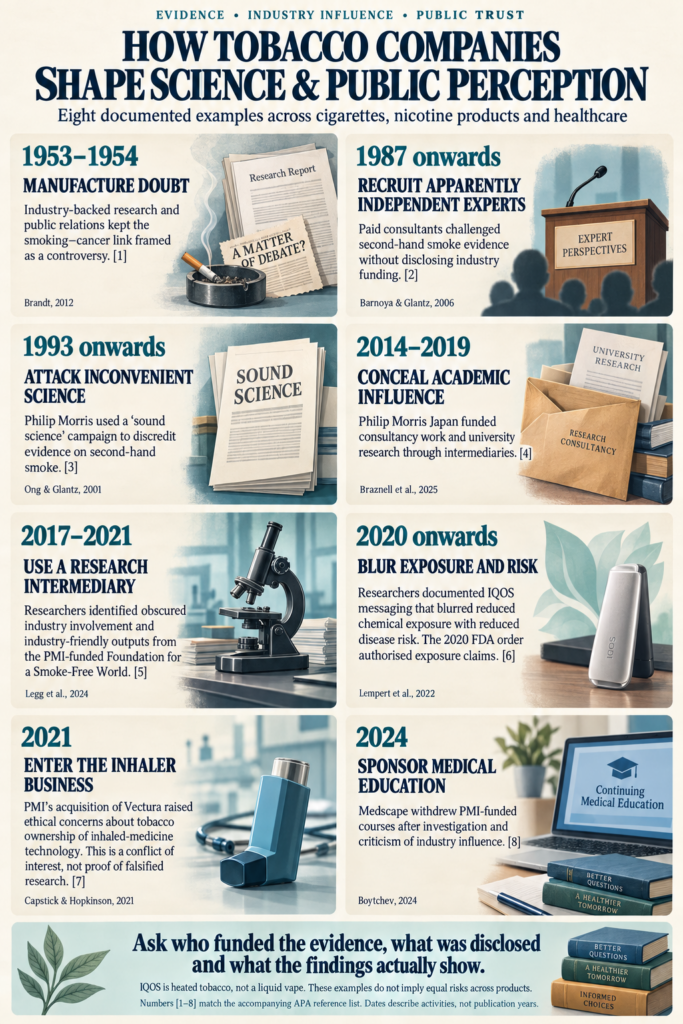
The accompanying infographic summarises eight documented examples. Its source numbers correspond to the same articles cited in this discussion. Dates on the infographic identify the activities; reference years identify the journal publications.
8 References
Barnoya, J., & Glantz, S. A. (2006). The tobacco industry’s worldwide ETS consultants project: European and Asian components. European Journal of Public Health, 16(1), 69–77. https://doi.org/10.1093/eurpub/cki044
Boytchev, H. (2024). Medscape caves in on courses funded by tobacco giant Philip Morris, while medics fear global push into medical education. BMJ, 385, q948. https://doi.org/10.1136/bmj.q948
Brandt, A. M. (2012). Inventing conflicts of interest: A history of tobacco industry tactics. American Journal of Public Health, 102(1), 63–71. https://doi.org/10.2105/AJPH.2011.300292
Braznell, S., Laurence, L., Fitzpatrick, I., & Gilmore, A. B. (2025). “Keep it a secret”: Leaked documents suggest Philip Morris International, and its Japanese affiliate, continue to exploit science for profit. Nicotine & Tobacco Research, 27(5), 794–804. https://doi.org/10.1093/ntr/ntae101
Capstick, T. G. D., & Hopkinson, N. S. (2021). Adapting inhaled medication practice in COPD and asthma to avoid funding the tobacco industry. International Journal of Chronic Obstructive Pulmonary Disease, 16, 2917–2923. https://doi.org/10.2147/COPD.S337066
Legg, T., Clift, B., & Gilmore, A. B. (2024). Document analysis of the Foundation for a Smoke-Free World’s scientific outputs and activities: A case study in contemporary tobacco industry agnogenesis. Tobacco Control, 33(4), 525–534. https://doi.org/10.1136/tc-2022-057667
Lempert, L. K., Bialous, S., & Glantz, S. (2022). FDA’s reduced exposure marketing order for IQOS: Why it is not a reliable global model. Tobacco Control, 31(e1), e83–e87. https://doi.org/10.1136/tobaccocontrol-2020-056316
Ong, E. K., & Glantz, S. A. (2001). Constructing “sound science” and “good epidemiology”: Tobacco, lawyers, and public relations firms. American Journal of Public Health, 91(11), 1749–1757. https://doi.org/10.2105/AJPH.91.11.1749