Ideally, Malaysia should move towards eliminating both cigarettes and vape. If that cannot be achieved at once, I believe vape should be banned first, including both open and closed systems. The rise of vaping among young people and the emergence of drug-laced products make further delay increasingly difficult to justify.
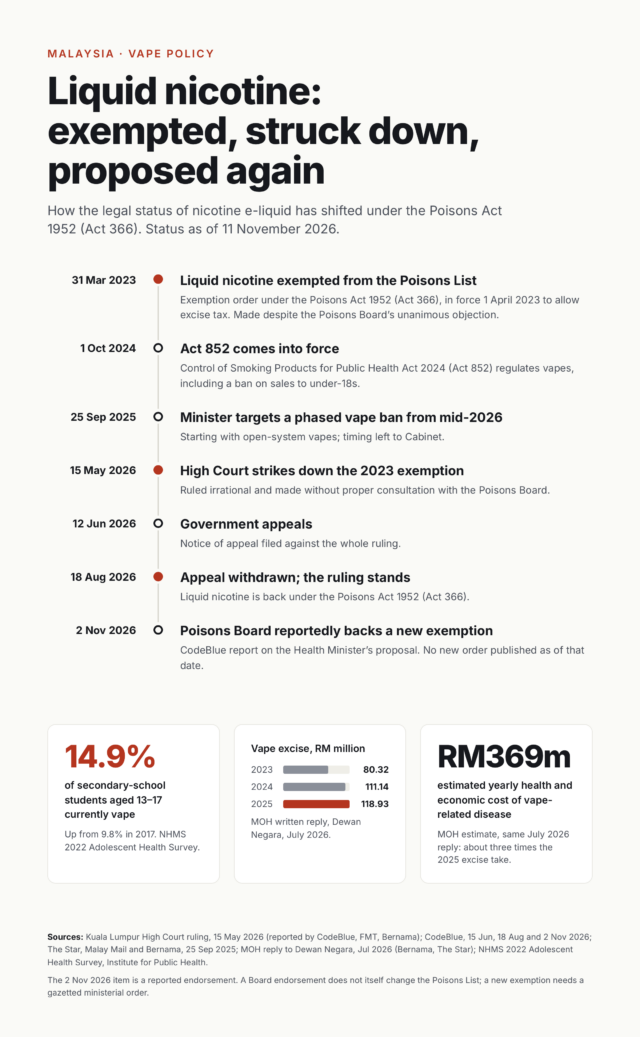
Yet despite repeated assurances, a nationwide ban has not materialised. On 25 September 2025, the Health Minister indicated that a phased ban could begin by mid-2026. Now, instead of implementing that commitment, the government is reportedly considering another exemption of liquid nicotine from the Poisons List.
Does the government genuinely intend to ban vape, or has its position changed?
There is speculation about political considerations, tax revenue and pressure from tobacco and vape businesses. Are existing industry investments and the prospect of legal challenges influencing government hesitation? Such explanations have not been substantiated, but the absence of a clear official rationale invites these questions. Industry associations have publicly argued for regulation under Act 852 instead of prohibition. That is their position. What is the government’s?
The fiscal argument is weak. According to the Ministry of Health, excise duty on vape products brought in RM118.93 million in 2025. The ministry also estimated an annual health and economic burden of around RM369 million from vape-related disease. These are different economic measures, and the latter is an estimate, not an observed 2025 bill. Nevertheless, the ministry itself stated that revenue does not justify allowing vape sales.
The legal history deepens the concern. On 15 May 2026, the High Court found the 2023 decision to exempt nicotine liquids and gels irrational and made without proper consultation with the Poisons Board. It concluded that economic considerations were a primary motivation. The government withdrew its appeal on 18 August 2026. Yet, on 2 November, CodeBlue reported that the Board had endorsed a new proposed exemption. That report concerns a proposal, not a newly gazetted ministerial order.
Much attention has turned to the relationship between the Poisons Act 1952 (Act 366) and the Control of Smoking Products for Public Health Act 2024 (Act 852). The legal questions are real, and changing the framework will require proper procedures. But legislation should implement an intelligible policy, not substitute for one. If the government seeks to prohibit recreational vaping, it must explain the legal route and transition. If it instead wants a permanent regulated market, it owes the public a health-based justification.
Enforcement capacity also deserves scrutiny. The ministry reported 683,704 premises inspected by 30 April 2026, alongside 233,831 compound notices under Act 852. That is substantial enforcement activity, but it cannot tell us whether youth access or dependence is declining. The most recent national adolescent survey cited here found current vape use rose from 9.8% in 2017 to 14.9% in 2022. Those figures precede Act 852 and cannot assess its impact.
At the same time, the ministry must deal with multiple healthcare pressures, including staffing, facilities and service delivery. We need evidence of improvements in outcomes, not merely larger allocations or higher enforcement counts. How sustainably can an already stretched health system supervise a large commercial vape market? This is not an argument against frontline officers. It is a reason to question whether regulation alone is a credible long-term strategy.
A prohibition would not magically end nicotine use. Illegal trade, smokers’ cessation needs and commercial transition would all require planning. Evidence that regulated nicotine e-cigarettes may help some adult smokers quit also deserves consideration. But potential benefits in smoking-cessation settings do not automatically justify open-ended recreational commercialisation, especially where children are exposed.
My position remains that Malaysia should ultimately eliminate both cigarettes and recreational vape, starting with vape if necessary. What is missing is not another round of speculation but a direct government answer: Is a ban still the goal, and if so, when? If the position has changed, why? And how much influence have industry arguments and possible commercial liabilities had on that decision?
Ultimately, political priorities are measured by decisions, not assurances. The health of the rakyat, particularly children, must take precedence over the commercial interests of the nicotine industry.
Sources
Bernama, 15 May 2026: High Court judgment; Malaysiakini, 19 August 2026: appeal withdrawal; MOH press compilation, 26 September 2025; Bernama, 29 July 2026: MOH excise and burden figures; Bernama, 1 June 2026: enforcement; NHMS 2022 fact sheet; CodeBlue, 2 November 2026: proposal; CodeBlue, 6 November 2026: industry view.