When discussing the future of employment in the age of artificial intelligence, I am more inclined to believe that many occupations will transform rather than disappear entirely. A doctor will probably remain a doctor, an engineer an engineer, and an accountant an accountant. However, what they do every day may be substantially different ten years from now.
Occupational transformation is nothing new. Computers, digital communication and automation have progressively changed how people work. What makes the present situation particularly interesting is that AI can now perform tasks previously considered part of specialised intellectual work.
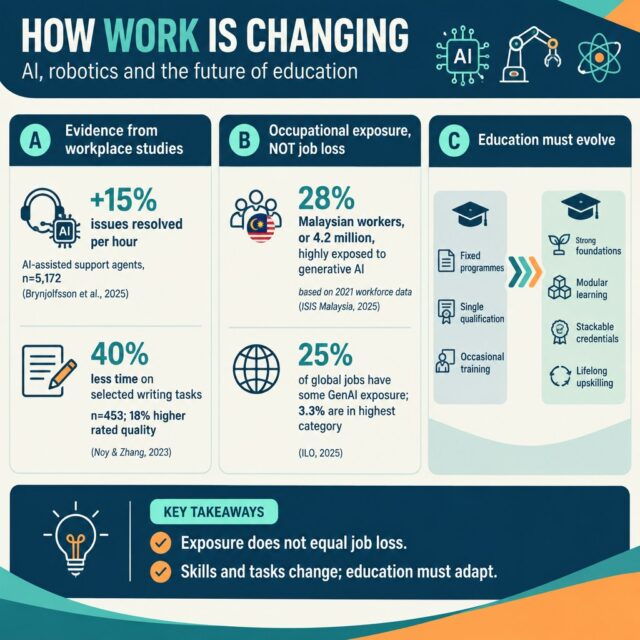
We are beginning to see measurable effects. A study involving 5,172 customer-support agents found that AI assistance increased productivity, measured by issues resolved per hour, by about 15%. Another experiment involving 453 college-educated professionals found that ChatGPT reduced the time required for selected writing tasks by 40%, while improving independently assessed output quality by 18%. These are findings about specific tasks and settings, not proof that entire occupations are disappearing.
Evidence about employment deserves greater caution. A Stanford study revised in 2026 reported that employment among workers aged 22 to 25 in highly AI-exposed occupations was 19% below a relative benchmark based on less-exposed occupations. Reduced hiring appeared important, but this observational difference cannot simply be attributed to AI.
For Malaysia, a 2025 ISIS Malaysia analysis estimated that approximately 4.2 million workers, or 28% of the workforce represented in its underlying 2021 data, were in occupations highly exposed to generative AI. This is an estimate of occupational exposure, not an estimate of job losses. Likewise, the International Labour Organization’s 2025 assessment suggests that transformation of tasks is more likely than wholesale elimination of occupations.
And AI is only one part of the wider technological landscape. Robotics is already changing physical work, while quantum technologies may create specialised opportunities in computing, sensing and cybersecurity. These technologies will not mature or affect employment at the same speed. We should resist treating all predictions as equally certain.
This brings me to a more important question: How should we prepare future generations when we cannot confidently predict what their jobs will look like?
Malaysia’s Higher Education Blueprint 2026–2035 offers an important direction through its emphasis on flexible education and lifelong learning. Rather than assuming one qualification will remain sufficient throughout a career, we should make it easier to gain new competencies through modular learning and recognised, stackable credentials.
A doctor might study AI applications in healthcare, an engineer robotics, and a scientist quantum technologies. Such professionals should not necessarily need another complete degree to acquire useful additional competencies. Yet the modules must fit coherent learning pathways. Freedom to collect certificates is not the same as developing expertise.
Foundational knowledge, critical thinking and professional judgement remain essential. Without understanding the principles of their discipline, graduates may struggle to recognise errors in AI-generated results. Universities must also reconsider assessment: polished written outputs alone are increasingly weak evidence of independent competence.
There is a related challenge in professional development. Routine entry-level tasks often provide the practice through which junior staff become experts. If automation removes some of those tasks, universities and employers will need alternative pathways for supervised experience and feedback.
For me, universities should evolve beyond institutions that prepare students for their first employment. They should become lifelong learning partners, allowing individuals to return, acquire new competencies and adapt as their occupations change. Accreditation, credit recognition, institutional collaboration, funding and employer acceptance must make this genuinely possible, without compromising standards.
We cannot predict every technology that will emerge. But we can build an education system that prepares people to continue learning and adapting throughout their professional lives.
Perhaps the success of higher education should increasingly be measured not only by how well graduates secure their first jobs, but also by how effectively they remain competent as those jobs change.
References
- Brynjolfsson, E., Li, D., & Raymond, L. R. (2025). Generative AI at work. The Quarterly Journal of Economics, 140(2), 889–942. https://doi.org/10.1093/qje/qjae044
- Noy, S., & Zhang, W. (2023). Experimental evidence on the productivity effects of generative artificial intelligence. Science, 381(6654), 187–192. https://doi.org/10.1126/science.adh2586
- Brynjolfsson, E., Chandar, B., & Chen, R. (2026). Canaries in the coal mine? Six facts about the recent employment effects of artificial intelligence. Stanford Digital Economy Lab. Research paper.
- Cheng, C., Chong, H., Dornan, M., & Jasmin, A. F. (2025). Novel AI technologies and the future of work in Malaysia. Institute of Strategic & International Studies Malaysia. Report.
- Gmyrek, P., et al. (2025). Generative AI and jobs: A refined global index of occupational exposure. International Labour Organization. https://doi.org/10.54394/HETP0387