Singapore’s increasingly firm approach towards vaping made me reflect on something broader than vaping itself.
Public health policy needs strong political support. Evidence and technical recommendations are important, but difficult measures become much harder when protecting health carries economic, commercial or political consequences.
Malaysia’s experience with nicotine illustrates this very well.
The decision in 2023
The government’s decision in 2023 to exempt liquid nicotine changed the environment. Vape products became more openly available. Businesses expanded and companies invested. The government began collecting excise revenue from nicotine-containing vape products.
Then came the Control of Smoking Products for Public Health Act 2024, or Act 852, which provided a regulatory framework for these products.
Whatever the intention at the time, these decisions created consequences. An industry has developed within a regulatory framework. Investment, employment, commercial interests and government revenue are now involved.
That makes reversing direction more difficult than it would have been in 2023.
And now, another exemption?
Following the court decision concerning the 2023 exemption, another exemption for liquid nicotine is now reportedly being pursued. The Poisons Board has reportedly considered the proposal through a secret ballot.
But we should be clear about responsibility. The Poisons Board is consulted and provides its view. The statutory decision ultimately rests with the Health Minister.
Because the ballot was secret, we also do not know how individual Board members voted. I therefore do not think we should focus too much on trying to interpret the position of individual members. The more important question is why the Minister and the government believe another exemption is necessary.
At the time of writing, I have not seen a clear official explanation of that policy rationale.
This matters because re-exempting nicotine may solve an immediate legal or regulatory problem, but it could make the longer-term problem even more complicated.
Every further step that allows the existing vape market to continue may strengthen the commercial and economic environment around it. Businesses may continue investing. Government continues receiving revenue. The industry becomes more established. If government later decides to prohibit vaping or impose much stronger restrictions, reversing course could become even harder and may invite further legal challenges.
This is particularly difficult to reconcile with the government’s stated direction towards eventually banning vape. If that remains the objective, then government should explain how another nicotine exemption moves Malaysia towards that objective rather than further away from it.
Government must own the consequences
Ultimately, the government that has been in power since 2023 must take responsibility for the consequences of the decision made in 2023.
If the government now accepts that the earlier direction was wrong from a public health perspective, then the answer should not simply be to recreate the same exemption because reversing it has become difficult.
There may now be economic costs. There may be resistance from industry. There may be fiscal implications and even legal challenges.
But these are consequences of the policy environment that government itself helped create.
Government must be prepared to own both its decisions and their consequences.
If correcting an earlier decision is now difficult, that difficulty should not itself become the justification for continuing the same direction.
I do not want to speculate about the Minister’s reasons for pursuing another exemption. There may be legal, regulatory, fiscal or practical considerations that are not yet publicly clear. That is precisely why an official explanation is important.
A decision made today can create an economic and political environment that makes a different public health decision tomorrow much more difficult.
The larger issue is political leadership
This is why the Singapore experience is interesting. Its government appears prepared to take increasingly strong measures against vaping despite the inconvenience and consequences of doing so. Whether one agrees with every measure or not, the political direction is clear.
But my concern is not only about nicotine.
The same principle applies to how we manage our healthcare system and how we look after our healthcare workers.
We frequently acknowledge that healthcare workers are essential. But acknowledgement must eventually become decisions about staffing, career pathways, remuneration, working conditions, facilities and the resources required to deliver good healthcare.
MOH must be firm in articulating and defending what the health system requires. But MOH cannot solve these problems alone.
JPA controls important aspects of the public-sector workforce. MOF has responsibility for the country’s finances and allocation of resources. Major reforms require Cabinet and political support.
Health therefore has to be a whole-of-government priority.
Every ministry has legitimate responsibilities. MOF must consider fiscal sustainability. JPA must consider the wider public service. Economic ministries must consider investment and employment.
But ultimately, government must decide where health sits among these competing priorities.
That is where political leadership is tested.
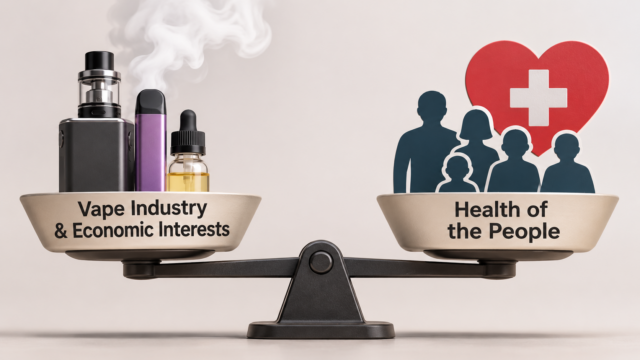
Public health decisions are relatively easy when everybody benefits and nobody loses. Leadership becomes much harder when protecting health means restricting a profitable industry, foregoing revenue, increasing public expenditure, facing legal challenges or making an unpopular decision.
Evidence can tell us what harms health. Public health professionals can recommend what should be done. MOH can advocate for it.
But ultimately, whether government is prepared to act, and to accept the consequences of acting, is a political decision.
Perhaps that is the larger lesson from Singapore’s approach to vaping and Malaysia’s experience with nicotine.
The strength of a country’s public health system depends not only on the strength of its Ministry of Health.
It depends on how strongly the government as a whole chooses to prioritise the health of its people, especially when doing so comes at a cost.